sacred mountain Shandong
Mount Tai
Foremost of the Five Great Mountains
World Heritage Site (1987) — mixed cultural and natural inscription
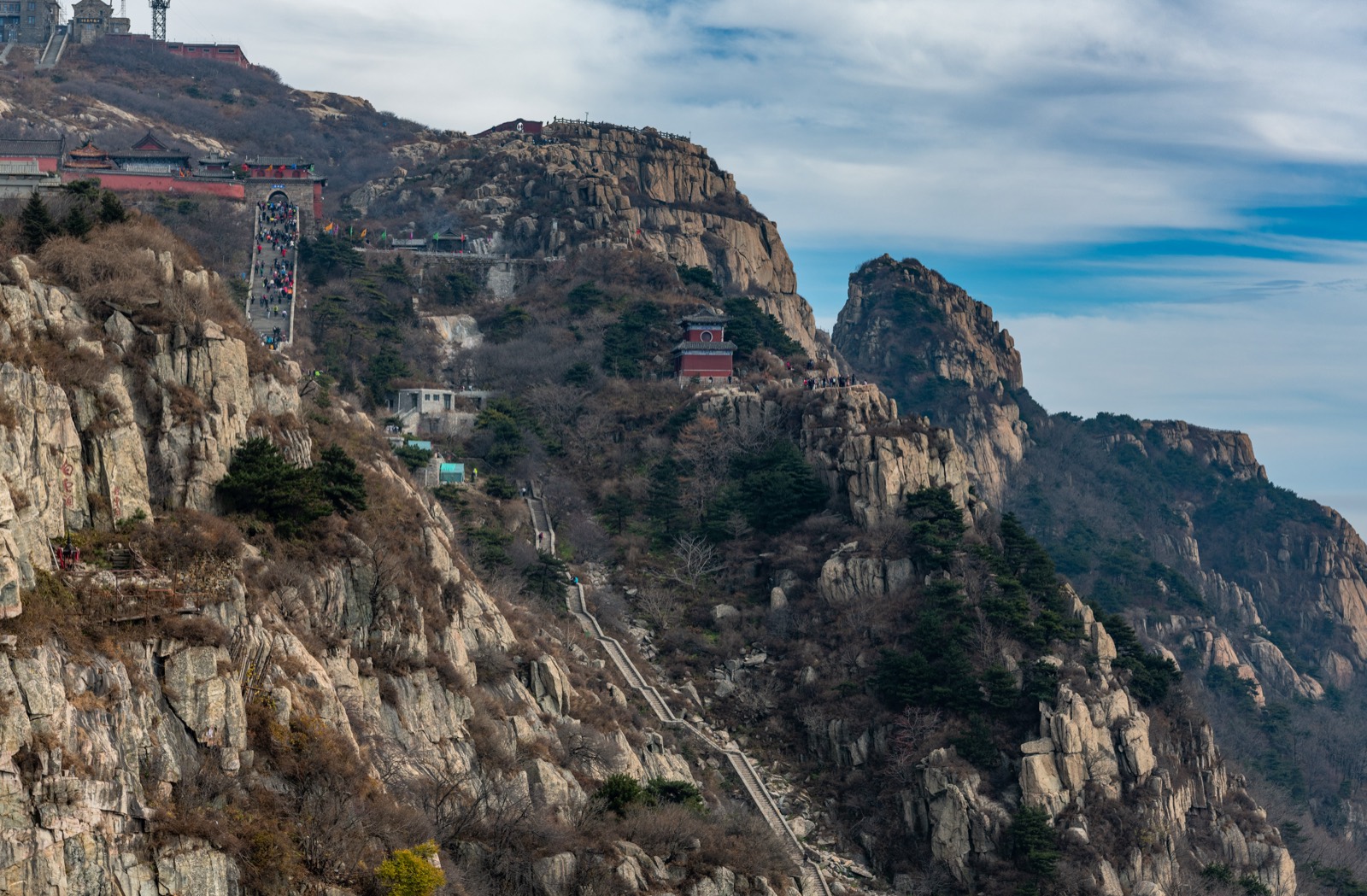
The Eastern Peak (Dongyue) and, by long convention, the first among the Five Great Mountains — the site where reigning emperors traveled to perform the feng and shan sacrifices, reporting the legitimacy and success of their rule directly to Heaven and Earth. No other Chinese mountain carried that specific constitutional weight. Mount Tai is also the principal cult center of Bixia Yuanjun, the "Princess of the Azure Clouds," a hugely popular folk-Taoist goddess of fertility, childbirth, and protection whose shrine near the summit draws pilgrims independent of the mountain's older imperial associations, and its base temple, Dai Miao, is among the largest ancient religious building complexes in China.
Sacred narrative
The imperial feng and shan sacrifices, and the cult of Bixia Yuanjun
For over two thousand years, an emperor's ascent of Mount Tai to perform the feng sacrifice (offered at the summit, to Heaven) and the shan sacrifice (offered at a lesser hill nearby, to Earth) was understood as one of the highest possible declarations of legitimate rule — an act so consequential that only a small number of emperors across Chinese history judged their reigns worthy of it. The practice bound the mountain permanently to the idea of cosmic and political order meeting in a single place. Alongside this state cult, and largely independent of it, grew the popular devotion to Bixia Yuanjun, whose shrine, the Bixia Ci, sits near the summit. She is venerated above all by ordinary pilgrims — especially women — seeking protection in childbirth and family fortune, and her festival draws crowds that dwarf any memory of the old imperial rites. The two cults, state ritual and popular goddess devotion, sit on the same mountain without ever fully merging into one story.
History
Founded Sacrificial site since at least the Qin dynasty (3rd century BCE); Dai Miao temple complex expanded across the Han, Tang, Song, and Qing dynasties.
Key figures
- Qin Shi Huang (first recorded imperial feng sacrifice, 219 BCE)
- Emperor Wu of Han
- Tang Xuanzong
- Song Zhenzong (last imperial feng and shan rites, 1008 CE)
- Bixia Yuanjun cult devotees
Major events
- 219 BCE: Qin Shi Huang performs the feng sacrifice at the summit, establishing the mountain's imperial role
- Han and Tang dynasties: successive emperors, including Han Wudi and Tang Xuanzong, perform their own ascents and rites
- 1008 CE: Song Zhenzong performs the last imperial feng and shan sacrifices recorded at Mount Tai
- 1987: UNESCO World Heritage inscription as a mixed cultural and natural site
Today
The site as it currently stands.
Cable car and a stone stairway of some 7,000 steps from Tai'an to the summit; both routes remain in active use
April–October; sunrise viewing from the summit is a major draw year-round
Tai'an, Shandong; Jinan (nearest major airport)
Active Taoist clergy at Dai Miao and the summit shrines; the Bixia Yuanjun festival remains a major annual pilgrimage event
peak season
Back to the geography
Return to Sacred sites, or read the concepts practised there.