sacred mountain Shaanxi
Mount Hua
The Western Peak of sheer granite cliffs
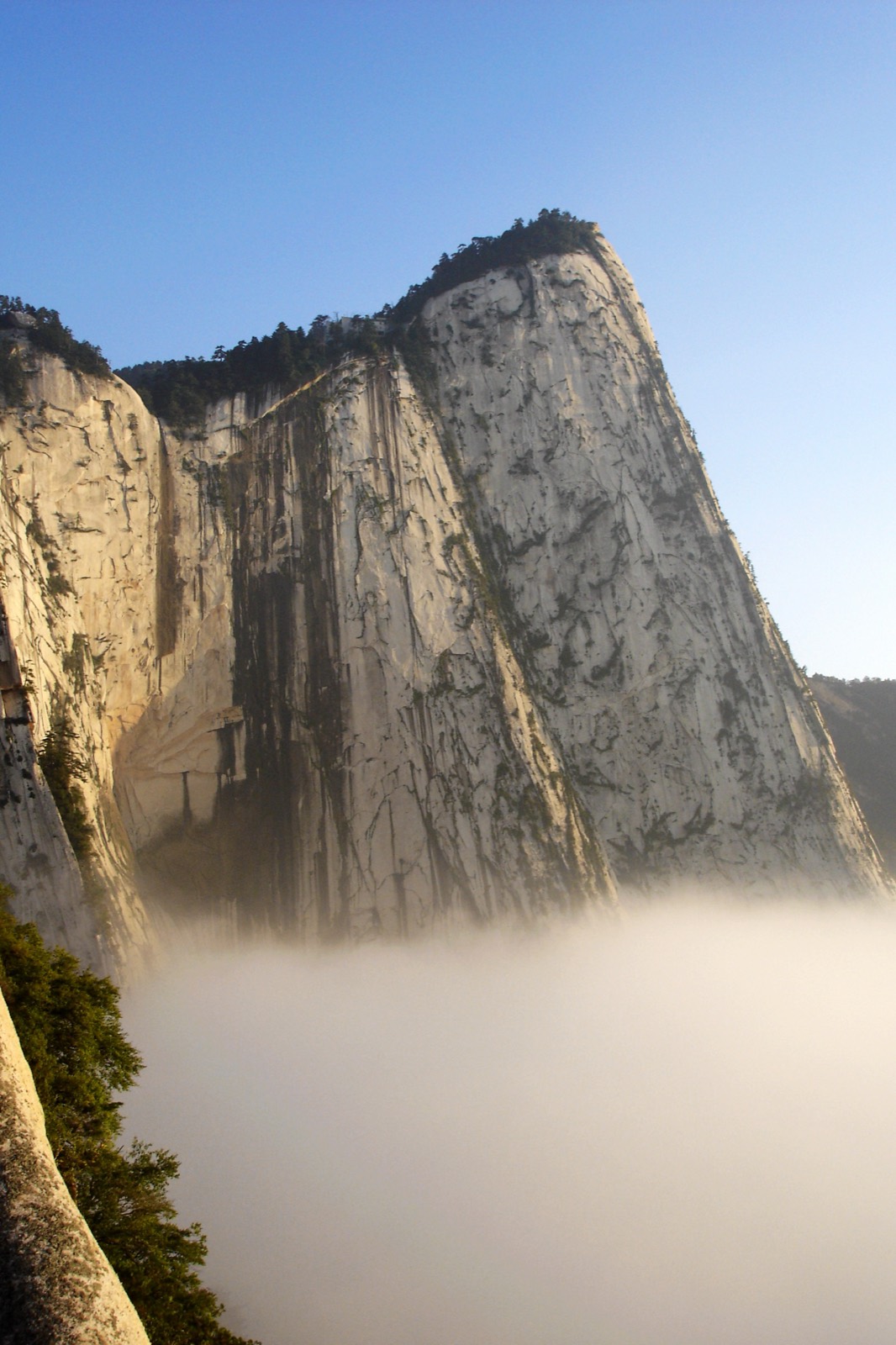
The Western Peak (Xiyue) of the Five Great Mountains, and the most physically dramatic of the five — a cluster of near-vertical granite peaks reached in places by plank walkways bolted directly into the cliff face. Its Taoist history is inseparable from Chen Tuan, a 10th-century recluse and master of internal cultivation and sleep-based meditation techniques who lived on the mountain for decades and became one of the most celebrated hermit-sages in the tradition. The main Taoist monastery at the mountain's base, Yuquan Yuan (Jade Spring Temple), was built in the Song dynasty specifically to commemorate him.
Sacred narrative
Chen Tuan's reclusion and mastery of sleep
Chen Tuan withdrew to Mount Hua after a life that, by his own account, held no more interest for him in official careers or worldly ambition. He became famous specifically for a cultivation technique built around extended, meditative sleep — sometimes recorded as lasting weeks — which he treated not as withdrawal from practice but as a discipline in itself, a way of nourishing internal energy by minimizing the body's ordinary expenditure. He is also credited, in later tradition, with early diagrams of cosmological patterning that fed into the historical development of the Taijitu (yin-yang symbol), though the precise transmission is debated by scholars. Local legend on the mountain holds that Chen Tuan once wagered the mountain itself in a game of Chinese chess against the founding emperor of the Song dynasty and won — a story still marked today by a small chess pavilion partway up the ascent. Historicity aside, the tale captures how completely Chen Tuan's reputation for detachment from worldly stakes came to define the mountain's character.
History
Founded Temple presence from at least the Han dynasty; Yuquan Yuan built in the Song dynasty to honor Chen Tuan.
Key figures
- Chen Tuan (Chen Xiyi), 10th-century hermit and cultivator
- Jia Deshun (disciple who built Yuquan Yuan in Chen Tuan's memory)
Major events
- Han dynasty: earliest recorded shrines to the God of the Western Peak
- 10th century: Chen Tuan retreats to Mount Hua, becoming one of Taoism's most celebrated hermit-cultivators
- Song dynasty: Yuquan Yuan built at the mountain's base to commemorate Chen Tuan; his tomb remains near the temple
- Ongoing: the plank-walk trails and cliffside temples remain a major hiking pilgrimage route
Today
The site as it currently stands.
Cable cars to the North and West Peaks; the historic plank walk (Changkong Zhandao) requires a safety harness and is not for those uneasy with heights
April–June and September–November
Huayin, Shaanxi; Xi'an (major hub, ~2hr by road/rail)
Resident Quanzhen clergy at Yuquan Yuan and the summit temples
busy
Back to the geography
Return to Sacred sites, or read the concepts practised there.