high deity Literature, scholarship, and success in the imperial examinations
Wenchang Wang
The Taoist god of literature, examinations, and scholarly success, whose cult grew directly out of the imperial civil service examination system and who remains, in the present day, a deity petitioned by students before exams.
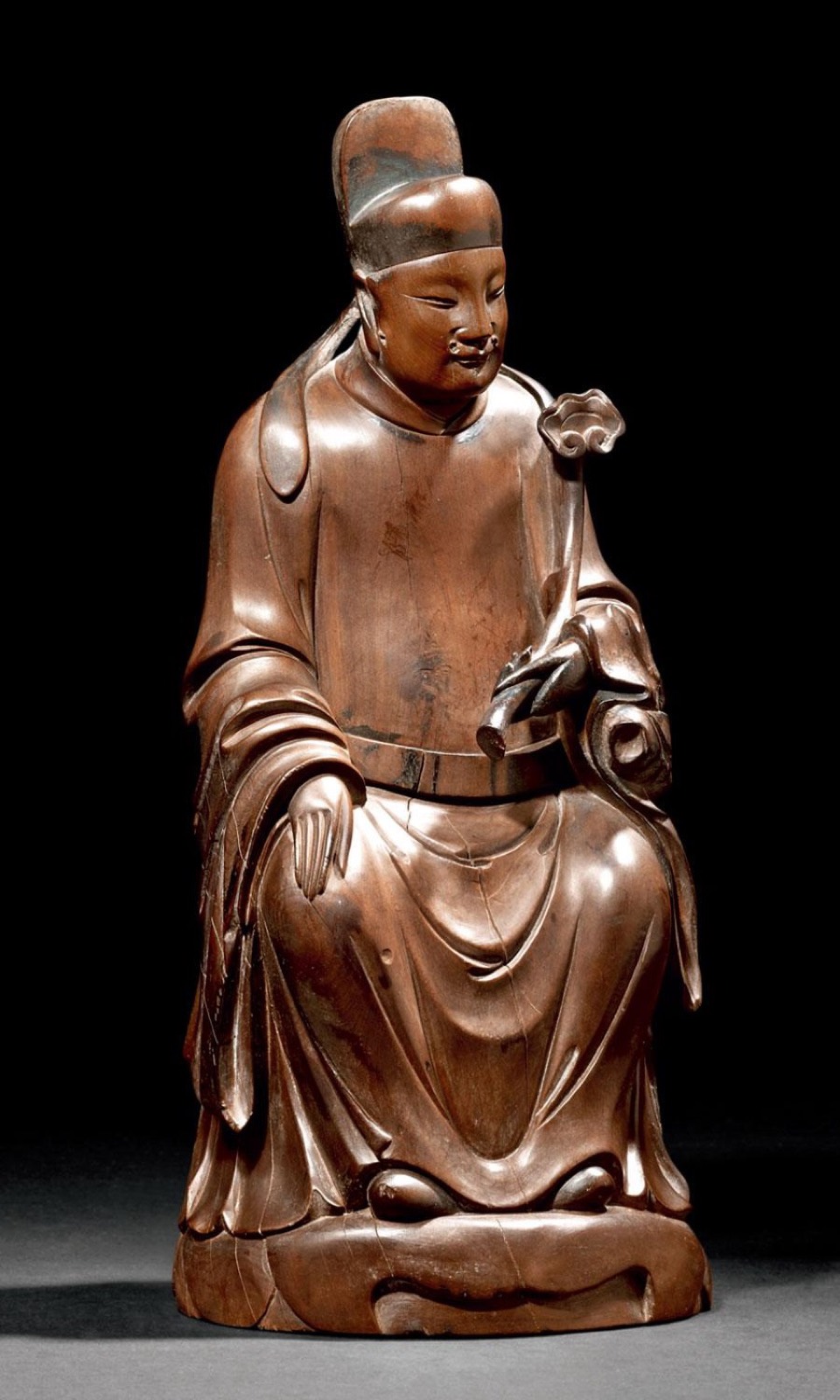
Wenchang Wang's cult fused two originally separate elements: an ancient astral cult centered on a constellation of six stars near the Big Dipper called Wenchang, believed to govern literary destiny, and the legend of Zitong Dijun, a deified local spirit from Sichuan associated with a historical or semi-historical scholar-official named Zhang Yazi. Over the Song and especially the Yuan dynasty, the imperial court formally merged the two and granted the resulting composite deity the title Wenchang Dijun, cementing him as the patron deity of the examination system that, for roughly thirteen centuries, was the primary route into the Chinese scholar-official class.
Because examination success determined not just individual careers but entire families' social standing, Wenchang temples clustered near examination halls and county schools throughout late imperial China, and students preparing for exams — along with their parents — routinely visited to pray for good results, burn incense, and sometimes leave a written petition. The examination system itself ended in 1905, but Wenchang's cult adapted rather than disappeared: he remains actively petitioned today by students before school entrance exams, university admissions tests, and professional qualification exams across mainland China, Taiwan, Hong Kong, and Chinese communities worldwide, making him one of the clearer examples of a Taoist deity whose devotional function has persisted by mapping cleanly onto a modern institutional equivalent of its original one.
Iconography
A scholar-official in civil dress holding a writing brush or scroll, often accompanied by two child attendants named Tianlong and Dima
Epithet
The God of Literature and Culture
Back to the pantheon
Return to Pantheon, or read the concepts behind these figures.