supreme The summit of the Taoist cosmos; the Dao made manifest in three forms
The Three Pure Ones
The three highest deities of the Taoist pantheon — Yuanshi Tianzun, Lingbao Tianzun, and Daode Tianzun (the deified Laozi) — representing three aspects of the Dao's primordial manifestation, enshrined together at the summit of nearly every major Taoist temple hall.
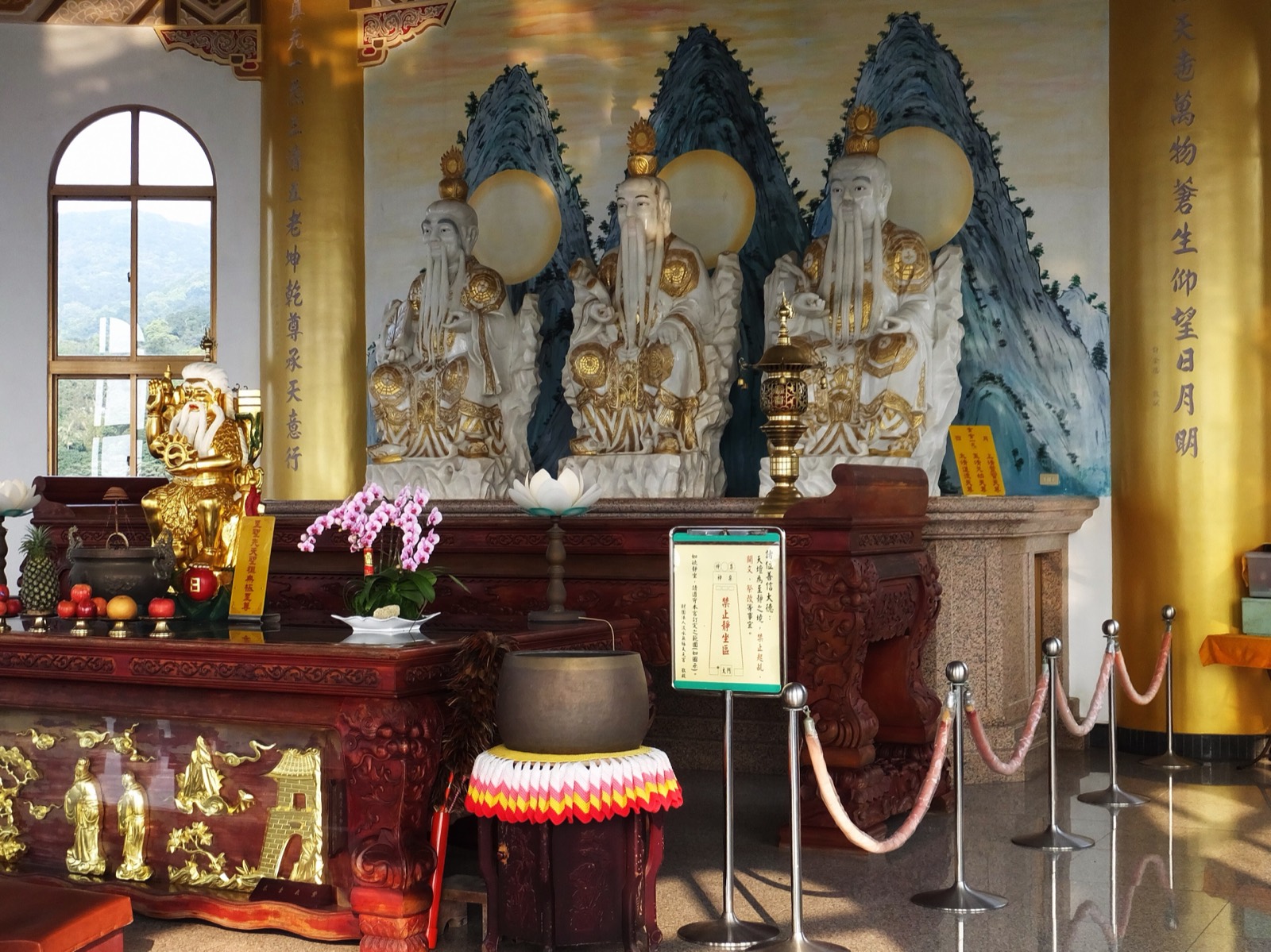
The Three Pure Ones sit above even the Jade Emperor in the strict cosmological hierarchy of religious Taoism, though the Jade Emperor is far more prominent in popular devotion and folk religion — a distinction that surprises many first-time visitors to a Taoist temple. The three are: Yuanshi Tianzun ("Celestial Venerable of the Primordial Beginning"), representing the Dao at the moment of cosmic origin; Lingbao Tianzun ("Celestial Venerable of the Numinous Treasure"), representing the Dao as it differentiates into yin and yang and the ordering of the cosmos; and Daode Tianzun ("Celestial Venerable of the Way and its Virtue"), who is Laozi himself in his highest deified form, representing the Dao as it is transmitted into the human world through teaching.
The Three Pure Ones are not three separate gods so much as three sequential emanations of a single underlying reality — a theological structure that maps loosely (and not coincidentally, given centuries of doctrinal cross-pollination) onto Buddhist trikaya (three-body) cosmology. They are enshrined together in the principal hall of nearly every major Taoist temple in China, typically seated in a row holding, respectively, a pearl (representing cosmic origin), a fan or ruyi scepter (representing cosmic order), and a fan or scroll (representing the Daodejing's teaching) — the visual anchor of the entire tradition's cosmology, present in miniature in nearly every temple hall a visitor will ever stand in.
Iconography
Three enthroned figures seated side by side, each holding a distinct ritual object (pearl, fan, scroll)
Epithet
The highest trinity of Taoist cosmology
Enshrined at
Where to find this figure.
Back to the pantheon
Return to Pantheon, or read the concepts behind these figures.