high deity Protection of seafarers, coastal communities, and safe passage
Mazu
A deified 10th-century woman from Fujian, venerated across coastal China, Taiwan, and the Chinese diaspora as protector of fishermen and sailors — one of the most widely worshipped deities in the Chinese-speaking world, whose exact religious classification (Taoist, Buddhist-influenced, or independent folk cult) is genuinely contested rather than settled.
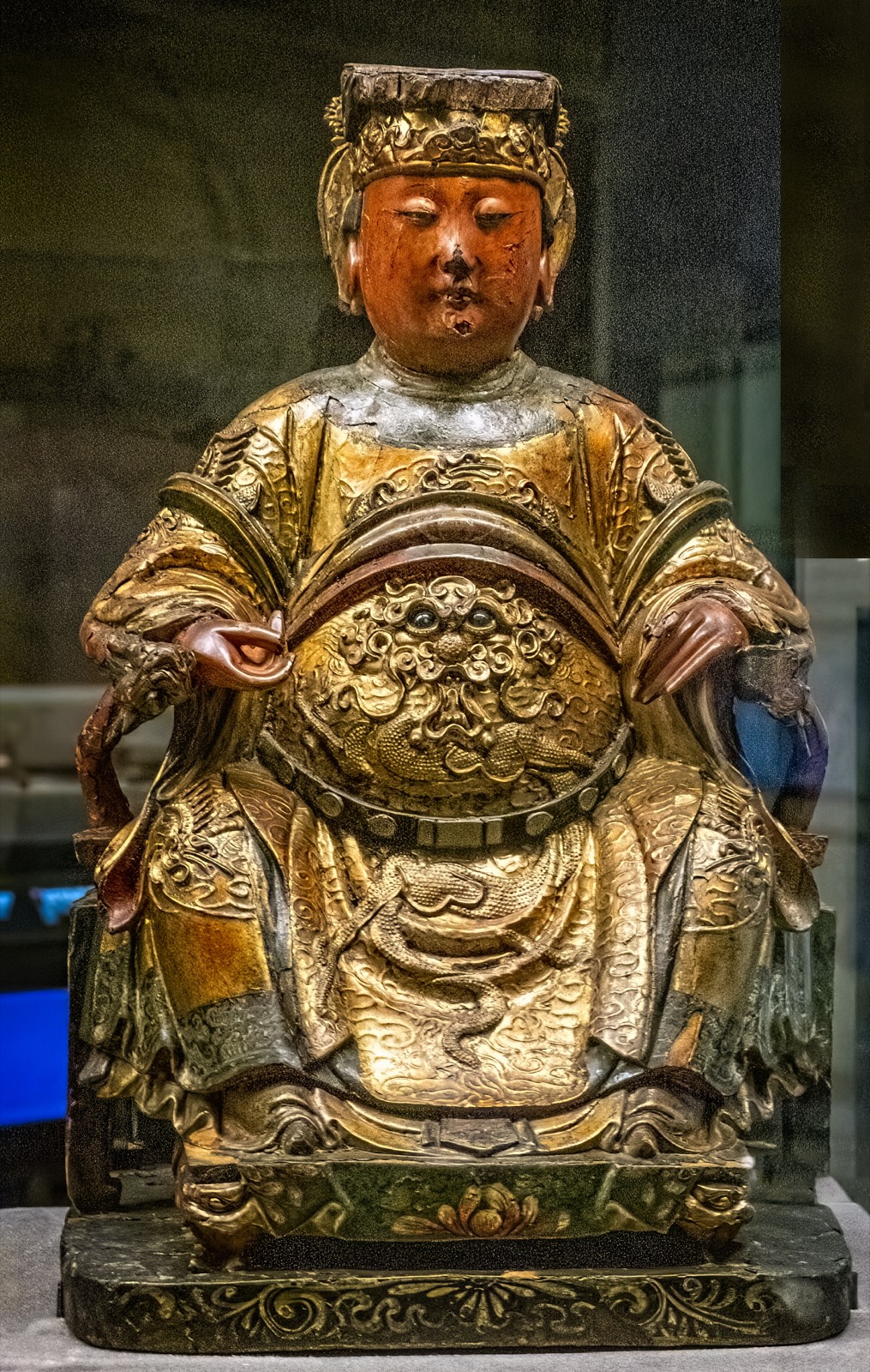
Mazu's origin story places her as Lin Mo (or Lin Moniang), born on Meizhou Island off the Fujian coast in the 10th century, a young woman said to have possessed the ability to foresee storms and to have died young — in the best-known version, drowning or dying in an attempt to rescue her father and brothers from a shipwreck. Local veneration of her as a protective spirit began soon after and spread with Fujianese and later Cantonese and Hokkien maritime trade and emigration, receiving successive imperial titles over the Song, Yuan, Ming, and Qing dynasties that escalated her from a local spirit to "Empress of Heaven" (Tianhou), the rank under which she is most commonly enshrined today. Temples to Mazu now number in the thousands across coastal China, Taiwan — where her cult is especially dominant and the Dajia Mazu pilgrimage draws hundreds of thousands of participants annually — Hong Kong, Macau, and overseas Chinese communities throughout Southeast Asia and beyond.
Where exactly Mazu belongs is a real point of definitional friction rather than a settled fact this platform should paper over. Taoist temples frequently enshrine her, Taoist priests frequently officiate her rites, and popular usage often simply calls her cult "Taoist" without qualification; at the same time, religious-studies scholarship more often classifies her worship as Chinese folk or popular religion — a huge, syncretic devotional field that overlaps with, borrows from, and is administered alongside organised Taoism without being formally reducible to it. The honest description is that Mazu sits within the broad devotional world Taoism operates in and often institutionally administers, while not being a deity whose cult originated from, or is doctrinally confined to, Taoist textual tradition.
Iconography
A serene crowned woman in imperial or bodhisattva-like robes, often flanked by two fierce attendant generals, Qianliyan ("Thousand-Mile Eyes") and Shunfeng'er ("Ears that Hear the Wind")
Epithet
The Empress of Heaven, goddess of the sea
Festival: 23rd day of the 3rd lunar month (her traditional birthday)
Back to the pantheon
Return to Pantheon, or read the concepts behind these figures.