immortal The wandering outsider; androgynous freedom from social role
Lan Caihe
The most ambiguous of the Eight Immortals — gender uncertain across different tellings, dressed in a ragged blue robe with one shoe on and one shoe off, wandering the streets singing prophetic songs and begging for alms which are given away as fast as they are received.
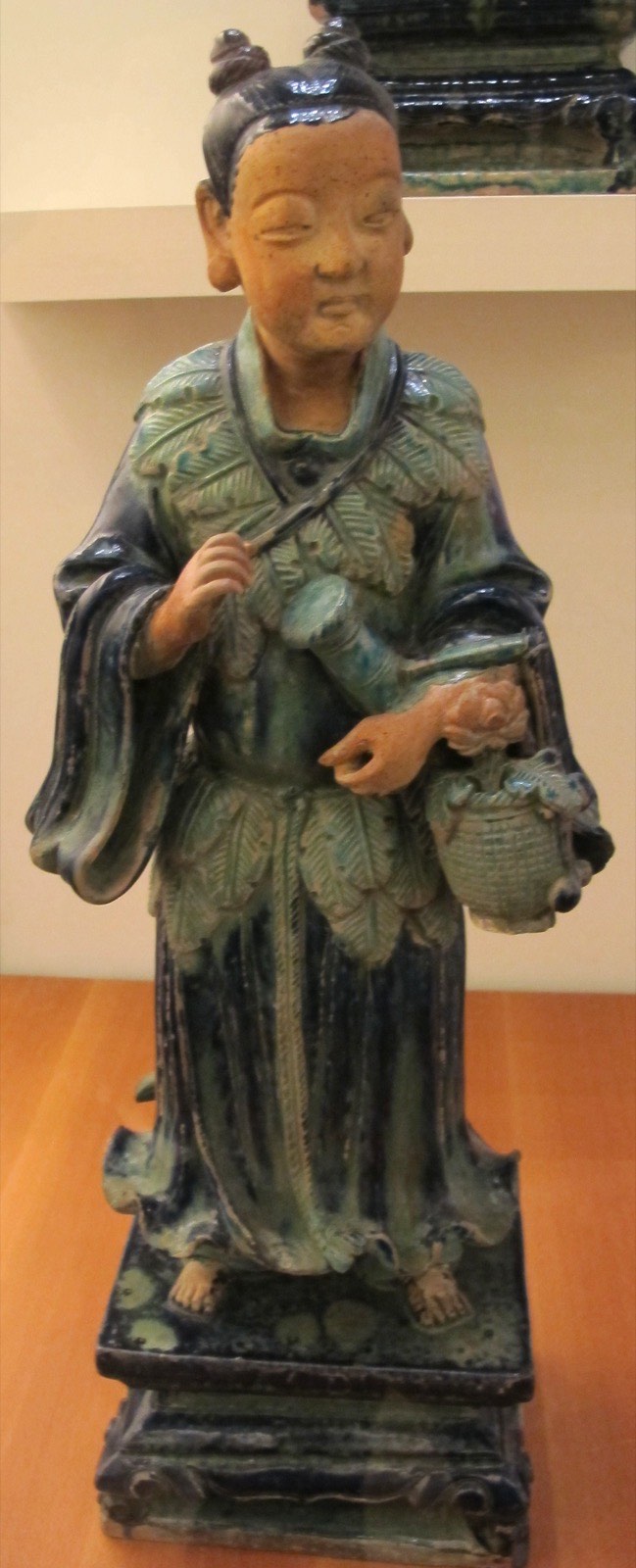
Where most of the Eight Immortals are given a fixed identity — a Tang general, a physician, a scholar — Lan Caihe is deliberately left unresolved. Some traditions describe a young man; others a young woman; still others describe someone who appears differently depending on who is looking, and this instability is treated as the whole point rather than an inconsistency to be resolved. Lan Caihe wanders the marketplace in a tattered blue gown, wearing a wooden clapper or holding a bamboo basket of flowers, singing verses that mix drunken nonsense with sudden flashes of prophetic clarity about the impermanence of wealth and status — coins given as alms are handed straight to other beggars or left scattered in the street, never kept.
The traditional account of Lan Caihe's departure from the world matches this pattern of refusal: while drinking and singing in a tavern, a crane descends from the clouds, and Lan Caihe casts off shoe, belt, robe, and clapper — each item floating down slowly through the air after the ascent — and rises away on the crane's back into the sky, leaving behind only the discarded costume of an ordinary social identity that was never truly worn in the first place. Lan Caihe is understood as patron of the itinerant, the performer, and anyone whose life does not fit the settled categories the rest of society is organized around.
Iconography
A young figure of ambiguous gender in a ragged blue robe, one shoe missing, carrying a flower basket and wooden clapper
Epithet
The Immortal Beggar-Minstrel
Back to the pantheon
Return to Pantheon, or read the concepts behind these figures.